

Direct Factory vs. Trading Company: How to Choose for Your Apparel Brand
“Are you a factory or a trading company?”
Few questions appear more frequently in apparel sourcing conversations. Behind it is a reasonable assumption: working directly with the manufacturer should mean better prices, greater transparency and more control over production.
Yet experienced sourcing professionals know that supply chains rarely operate that simply.
Factory ownership does not automatically guarantee technical expertise. Working through an intermediary does not necessarily mean unnecessary costs. Even two manufacturers operating within the same product category may offer very different levels of development support.
Choosing the right sourcing model requires a closer look at where value is created, how production is managed and which responsibilities your brand is prepared to take on.
1. The Business Model Only Tells Part of the Story
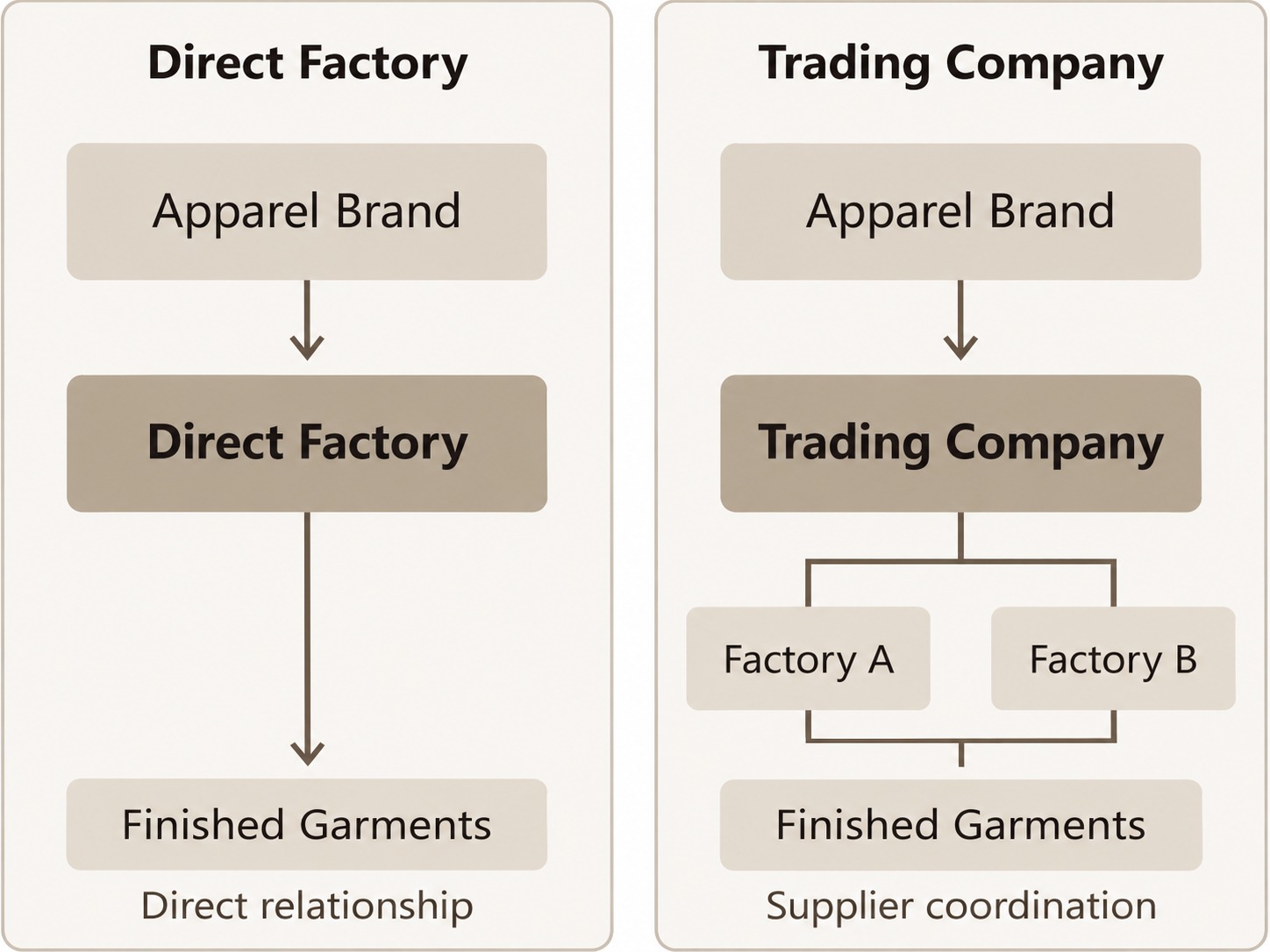
The traditional distinction between factories and trading companies is relatively straightforward.
Manufacturers invest in production facilities, equipment, skilled workers and technical processes. Trading companies build supplier networks, facilitate commercial relationships and coordinate sourcing activities.
In practice, the boundaries often overlap.
Modern apparel manufacturers may operate their own design, fabric sourcing, merchandising and sample development departments. Established trading companies sometimes employ garment technicians, quality inspectors and sourcing specialists.
Others combine owned production facilities with external manufacturing partners.
 factory-vs-trading-company-sourcing-models
For buyers, these differences are worth understanding before comparing suppliers.
Ownership of a sewing facility reveals where certain manufacturing activities take place. It does not necessarily explain who develops the fabric, reviews fit corrections, manages specialist treatments or approves production changes.
Those responsibilities can have a significant influence on the finished product.
2. Price per Garment vs. Total Sourcing Cost
Direct factory pricing is often perceived as the more economical option. Removing an intermediary can reduce certain commercial costs, particularly when order volumes are stable and product requirements are clearly defined.
However, consider the operational requirements of developing a seasonal collection containing embroidered sweatshirts, modal-blend loungewear and lightweight woven jackets.
Each category may require different production capabilities, material suppliers and technical expertise.
Sourcing independently from several specialist manufacturers could result in attractive individual quotations. Managing those relationships also introduces additional work:
- Coordinating fabric and trim development
- Reviewing samples across multiple suppliers
- Managing separate production schedules
- Organizing inspections and shipment arrangements
- Resolving technical issues between different parties
Centralized sourcing through an experienced trading company may reduce some of that workload, although the service will be reflected in its pricing.
Integrated manufacturers may offer another solution by combining production and development resources within one commercial relationship.
The financial comparison becomes more meaningful when buyers evaluate the complete sourcing cost rather than the unit price alone.
3. Technical Communication Can Change the Outcome
Picture a product development meeting shortly before bulk cutting.
The approved sweatshirt was developed using 320 GSM cotton-rich fabric. The bulk material meets the specified composition and weight, but its surface feels noticeably different.
An experienced technician might investigate the yarn, knitting construction, finishing treatment or fabric processing conditions.
Someone without sufficient textile knowledge might simply confirm that the specification is correct.
Both responses address the same material. Only one investigates why the finished product could differ.

apparel-sample-review-and-technical-communication
Situations like these reveal the importance of technical access within a sourcing relationship.
Direct communication with fabric specialists, pattern makers and production technicians can help resolve development issues before they become manufacturing problems.
Trading companies with strong technical teams may provide comparable support. Difficulties arise when the people communicating with the buyer lack sufficient understanding of the garment or the authority to coordinate the necessary action.
For apparel collections involving specialized fabrics, complex construction or demanding fit requirements, the quality of technical communication deserves considerable attention.
4. Comparing the Two Sourcing Models
The following comparison reflects common characteristics within the apparel industry. Individual suppliers may operate differently.
| Evaluation Criteria | Factory | Trading Company |
|---|---|---|
| Core expertise | Manufacturing and technical execution | Supplier sourcing and coordination |
| Pricing structure | Direct production quotation | Product cost plus service or commercial margin |
| Product specialization | Often focused on selected categories | Potentially broader category coverage |
| Technical access | May offer direct access to production specialists | Depends on internal expertise and factory relationships |
| Production visibility | Potentially greater access to owned facilities | Depends on supplier transparency |
| Development support | Varies according to internal capabilities | Varies according to technical resources |
| Quality management | May directly supervise production processes | Depends on inspection and supplier management |
| Supply flexibility | Influenced by production capacity | May access alternative manufacturing resources |
The distinction becomes particularly relevant when evaluating the level of support required beyond manufacturing itself.
Some brands need little assistance with product development. Others rely heavily on their suppliers to interpret designs, recommend materials and refine garment construction.
The same sourcing arrangement will not serve both businesses equally well.
5. Three Brand Situations, Three Different Priorities
Established Brands with Repeat Production
For businesses with proven product ranges, stable specifications and recurring orders, continuity becomes increasingly important.
Maintaining fabric characteristics, measurement standards, construction details and finishing quality across multiple production runs can protect the identity of an established product.
Long-term relationships with specialist manufacturers may help preserve that accumulated product knowledge.
Brands Expanding Their Product Categories
Entering an unfamiliar category presents different challenges.
An activewear brand introducing woven casualwear, for example, may require expertise that its existing supplier network cannot provide.
Access to several manufacturing specialists through an experienced sourcing partner could make category expansion more manageable, particularly when internal sourcing resources are limited.
Brands Building More Integrated Collections
Seasonal collections often require coordination between fabric development, design interpretation, sampling, fit adjustments and different garment techniques.
Managing each activity independently can create unnecessary complexity.
Manufacturers with integrated development capabilities may be suitable when brands need both technical support and production execution within a coordinated structure.
The sourcing priorities of a brand preparing its first collection can differ considerably from those of a business managing established international distribution.
Supplier relationships should develop accordingly.
6. Outsourcing Is More Common Than Many Buyers Realize
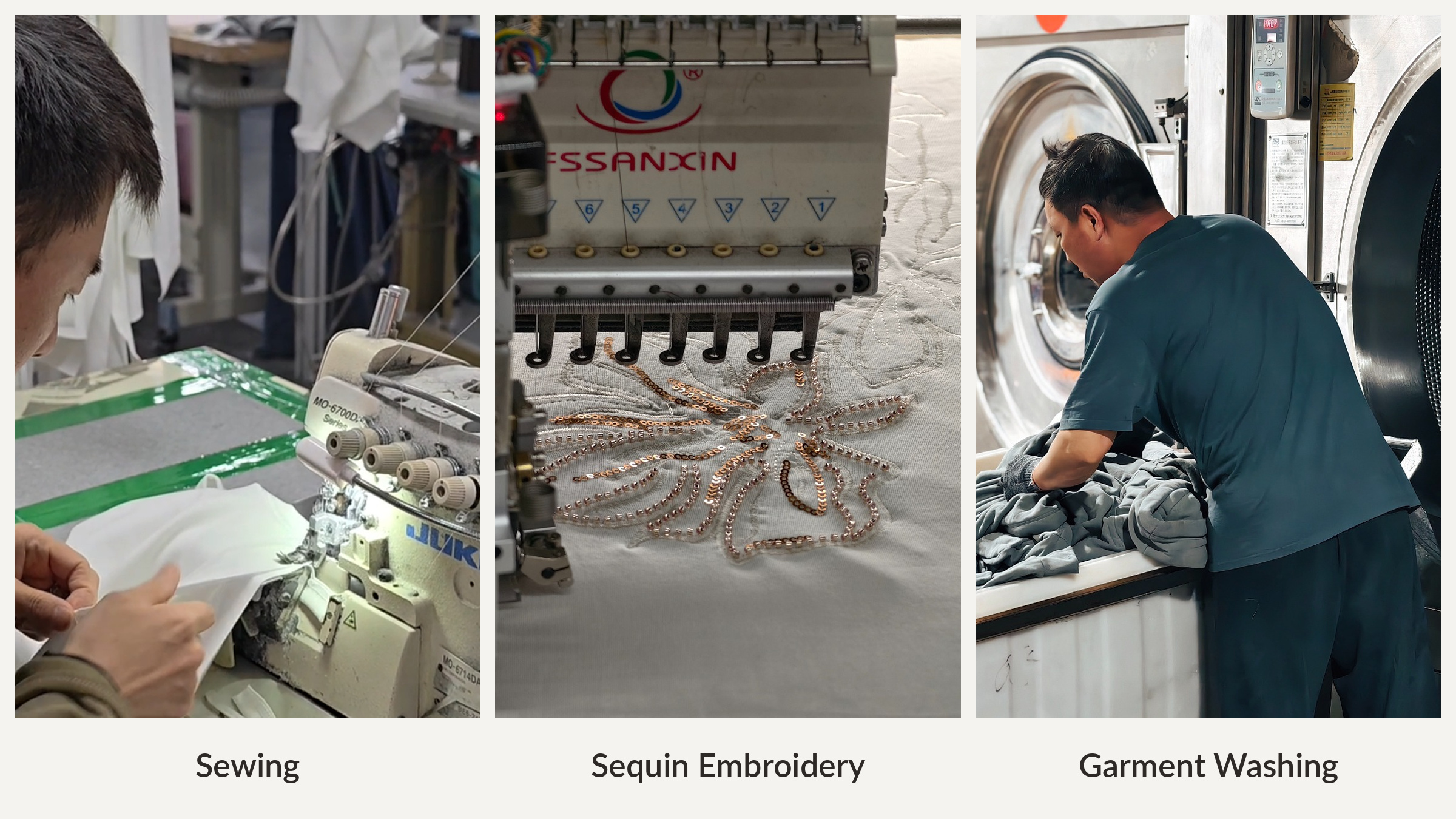
Printing. Embroidery. Garment dyeing. Washing. Laser treatments.
These processes require different machinery, technical knowledge and operating conditions.
Even experienced garment manufacturers may rely on specialist partners for selected operations rather than maintaining every capability within one facility.
garment-manufacturing-and-specialist-processes
Using external production resources can be commercially and technically sensible.
Problems develop when production arrangements become difficult to trace, approved requirements are not communicated accurately, or responsibilities become unclear between companies.
Experienced buyers therefore examine how external processes are managed instead of treating outsourcing as an automatic disadvantage.
Knowing where production takes place is valuable. Knowing how quality and responsibility are maintained throughout that production is equally important.
7. Before Making a Decision, Look at These Six Areas
Supplier evaluations become more useful when they move beyond company descriptions and focus on operational evidence.
- Product Expertise: Has the supplier developed garments with comparable fabrics, construction and technical requirements?
- Development Resources: Who reviews technical specifications, fit comments and material alternatives?
- Production Transparency: Can the supplier explain where the garments will be made and which specialist processes are handled externally?
- Quality Management: How are approved specifications translated into measurable production standards?
- Commercial Clarity: Does the quotation clearly define the materials, processes, services and responsibilities included?
- Production Continuity: How will approved standards be maintained when the brand places another order?
These considerations provide a more complete picture of the relationship your brand is about to enter.
The Better Sourcing Decision
Working directly with a factory offers meaningful advantages when manufacturing expertise, technical communication and production continuity are central to the collection.
Trading companies can provide valuable flexibility when supplier discovery, category expansion and centralized coordination are greater priorities.
Integrated apparel manufacturers may combine elements of both approaches.
Ultimately, selecting a sourcing partner should involve more than comparing supplier types or negotiating a lower price.
The commercial consequences of that decision often become visible months later — when garments reach the market, customers respond to the quality, and the brand decides whether to place another order.
Your customers will never ask whether their clothes came from a factory or a trading company. They will judge the product they receive.
Build the Right Manufacturing Partnership
Choosing the right apparel manufacturing partner starts with understanding your product requirements, development priorities and long-term sourcing goals.
At Ambition Garment, fabric sourcing, product development, sampling and garment manufacturing are coordinated to support your collection from concept to delivery.
Whether you are developing a new collection or reviewing your existing sourcing strategy, share your product requirements with our team to explore the right manufacturing solution.