

DTG vs Screen Printing: Choosing the Right Method for Clothing Production
DTG vs screen printing is a common decision for clothing brands developing custom printed garments. DTG is generally well suited to detailed, multicolor designs and smaller production runs, while screen printing can offer better production efficiency for repeat graphics at higher quantities. The right choice depends on the actual artwork, fabric, order size, print feel and quality expectations.
For example, a photographic print on a cotton T-shirt may benefit from the flexibility of direct-to-garment printing. A two-color logo repeated across a large sweatshirt order may be better suited to screen printing. Yet the decision becomes more complicated when the fabric contains polyester, the print covers a large area or the approved sample must be reproduced consistently in bulk.
This guide explains how both methods work, what affects printing costs and durability, and how apparel brands can evaluate the most suitable process before committing to production.
The differences between these printing methods become clearer when they are compared against actual production requirements.
| Factor | DTG Printing | Screen Printing |
|---|---|---|
| Process | Digital inkjet printing directly onto the garment | Ink transferred through prepared mesh screens |
| Artwork | Well suited to detailed images, gradients and many colors | Efficient for defined colors and repeat graphics; complex designs require suitable separations |
| Setup | Digital preparation, garment setup and pretreatment where required | Screen preparation, registration and press setup |
| Order quantity | Often practical for smaller runs and artwork variations | Often more economical when stable designs are repeated at scale |
| Fabric | Commonly optimized for cotton-rich garments | Can accommodate a broad range of fabrics with appropriate inks |
| Print feel | Depends on ink coverage, pretreatment and underbase | Depends on ink type, deposit thickness and technique |
| Durability | Depends on preparation, curing, fabric and laundering | Depends on ink compatibility, curing, fabric and laundering |
Key takeaway: Neither printing method is universally better. The strongest choice is the one that matches the design requirements and can be repeated consistently on the intended production garment.
What Is DTG Printing?
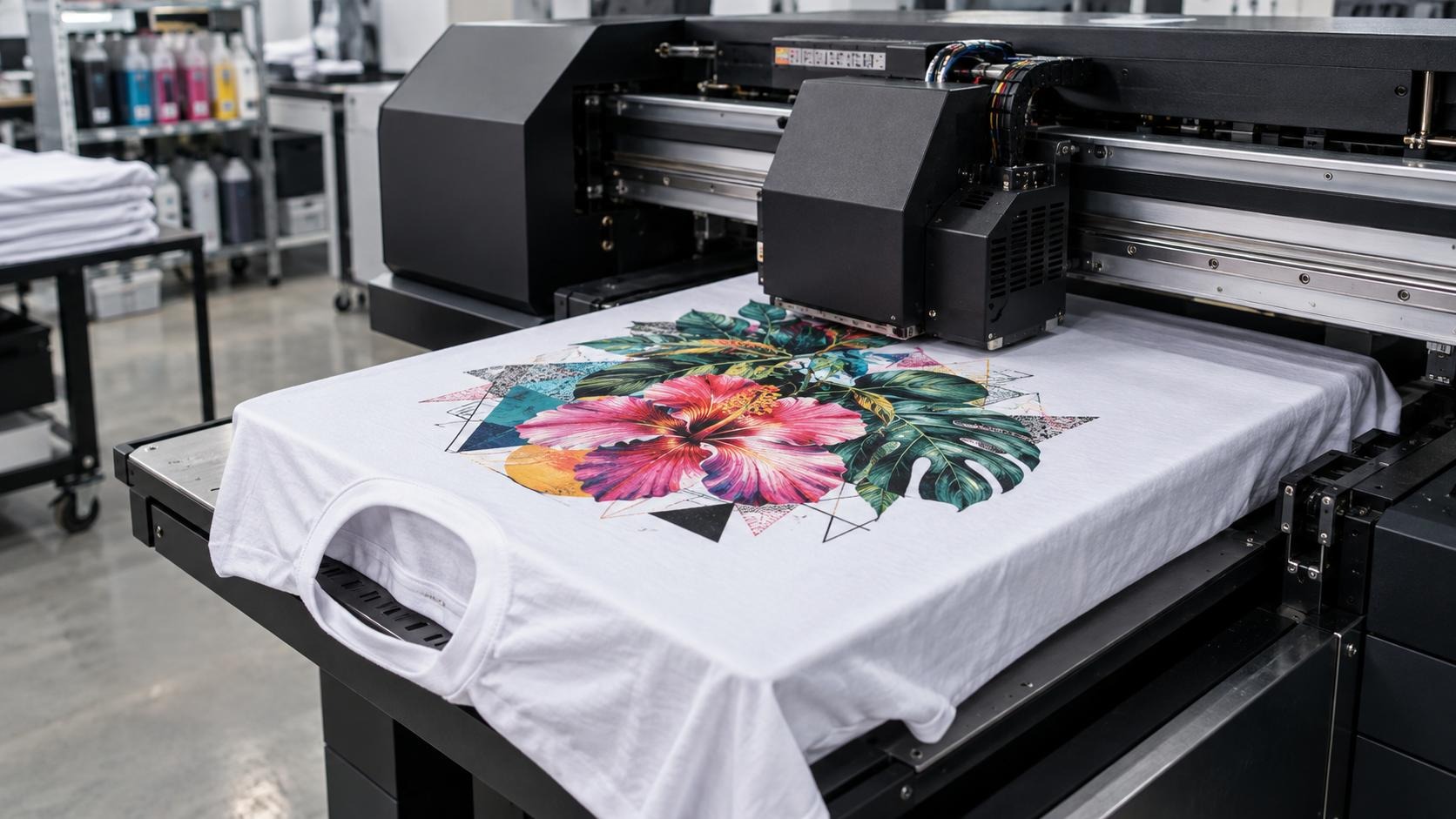
Direct-to-garment printing, commonly called DTG printing, is a digital method that uses specialized inkjet equipment to apply textile inks directly to a garment. Unlike screen printing, it does not require a separate physical screen for each printed color.
This makes DTG particularly useful for designs containing photographic detail, subtle gradients, illustrations and multiple colors. Clothing brands can develop several graphic concepts without preparing an individual set of printing screens for every design.
The production process generally includes artwork preparation, garment pretreatment when required, printing, ink curing and inspection. Dark-colored garments often need additional pretreatment and a white ink underbase, depending on the equipment and ink system.
Advantages of DTG Printing
- Detailed artwork: Suitable for photographic designs, fine illustrations and color gradients.
- Design flexibility: Artwork can be changed digitally without preparing new screens.
- Short-run practicality: Useful when order quantities are too small to distribute screen setup costs efficiently.
- Sampling flexibility: Multiple graphic concepts can be evaluated during product development.
Limitations of DTG Printing
DTG output depends on the compatibility of the fabric, ink system and pretreatment process. Cotton-rich garments are common applications, while polyester and specialty fabrics may require different equipment or printing chemistry.
Production speed also matters. Each garment requires individual printing and curing operations, so larger orders may not gain the same setup-cost advantage that screen printing can achieve with a stable design.
What Is Screen Printing?
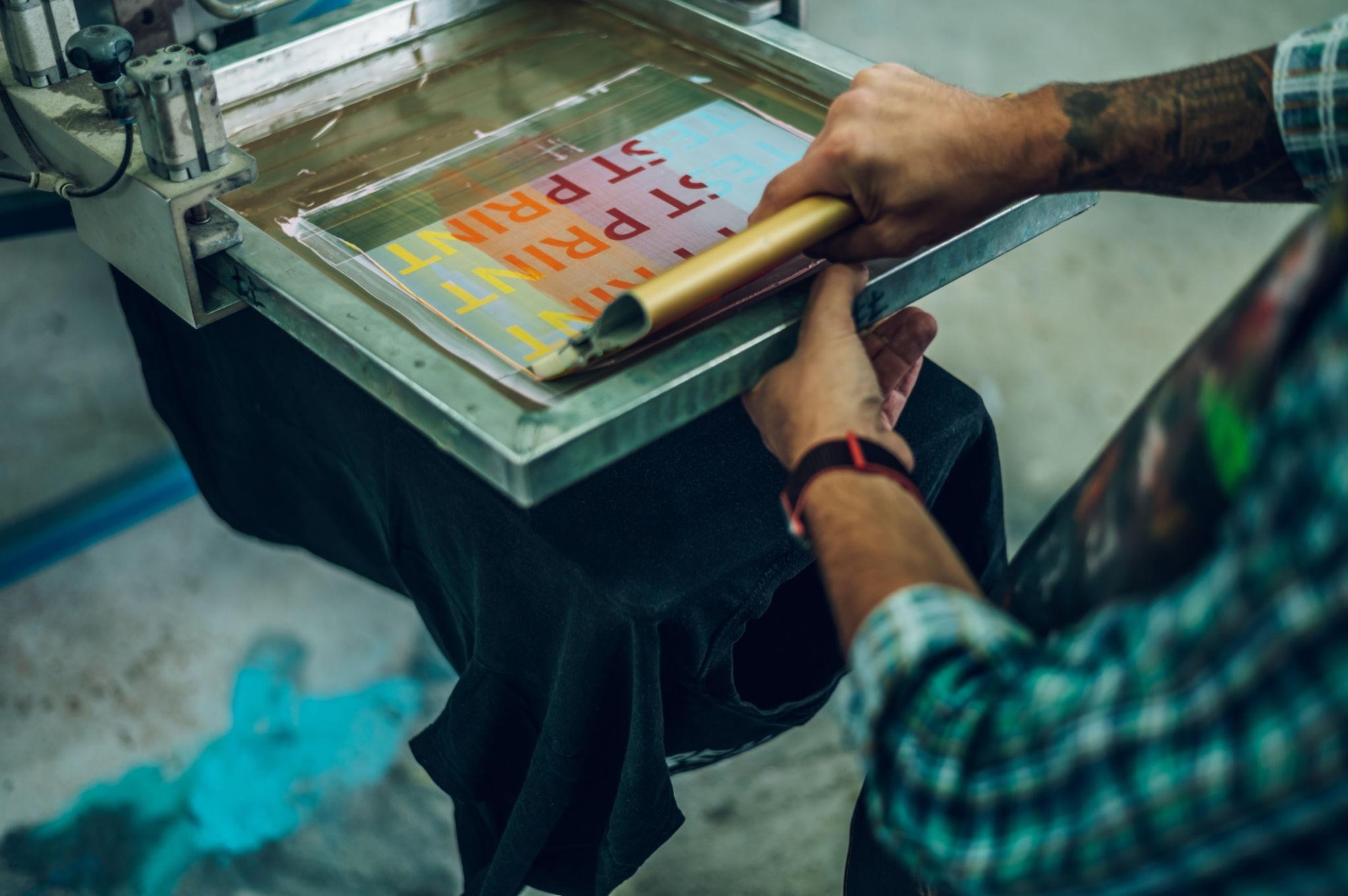
Screen printing is a textile decoration method that transfers ink through a mesh stencil onto the garment. Artwork is separated into printable layers, screens are prepared and ink is pushed through the open areas using a squeegee.
A design may require one screen or multiple screens depending on the colors, underbase and special effects involved. Once the press has been prepared and the print registration is approved, the artwork can be repeated across a production run.
Screen printing is widely used for branded T-shirts, sweatshirts, hoodies, uniforms and casualwear. The selected ink system can produce different finishes, including soft-hand graphics, opaque prints and raised or textured effects.
Advantages of Screen Printing
- Repeat production: Efficient when the same artwork is printed across many garments.
- Color control: Spot-color systems can support consistent brand graphics when properly managed.
- Finish options: Different ink systems allow a wide range of visual and tactile effects.
- Fabric versatility: Suitable systems can be selected for cotton, blends and various performance materials.
Limitations of Screen Printing
Screen preparation and press setup introduce costs before production begins. Designs with many colors, intricate separations or frequent artwork changes may require additional preparation.
Fine gradients and photographic imagery are possible with advanced screen-printing techniques, but they require appropriate artwork separations, halftone control and registration. They should not be treated as identical to a digital print without physical sampling.
How DTG and Screen Printing Work in Production
Both techniques require an approved design and controlled curing conditions, but their workflows differ. Understanding these steps helps explain why their costs, lead times and production risks are not the same.
DTG Printing Workflow
Preparation
Pretreatment
Printing
Curing
Inspection
Screen Printing Workflow
Separations
Preparation
Registration
Curing
Inspection
In DTG production, changing a graphic is often relatively straightforward, although pretreatment, print time and curing still apply to each garment. In screen printing, the initial setup is more involved, but a repeated design can benefit from an established production process.
For both methods, print placement, fabric batches, machine settings and finishing conditions must remain controlled. A visually successful sample is not automatically proof that the same result will be achieved throughout bulk production.
DTG vs Screen Printing Quality: Color, Detail and Hand Feel
Print quality should be evaluated against the artwork and intended garment rather than by assuming one method produces a superior result.
DTG Printing
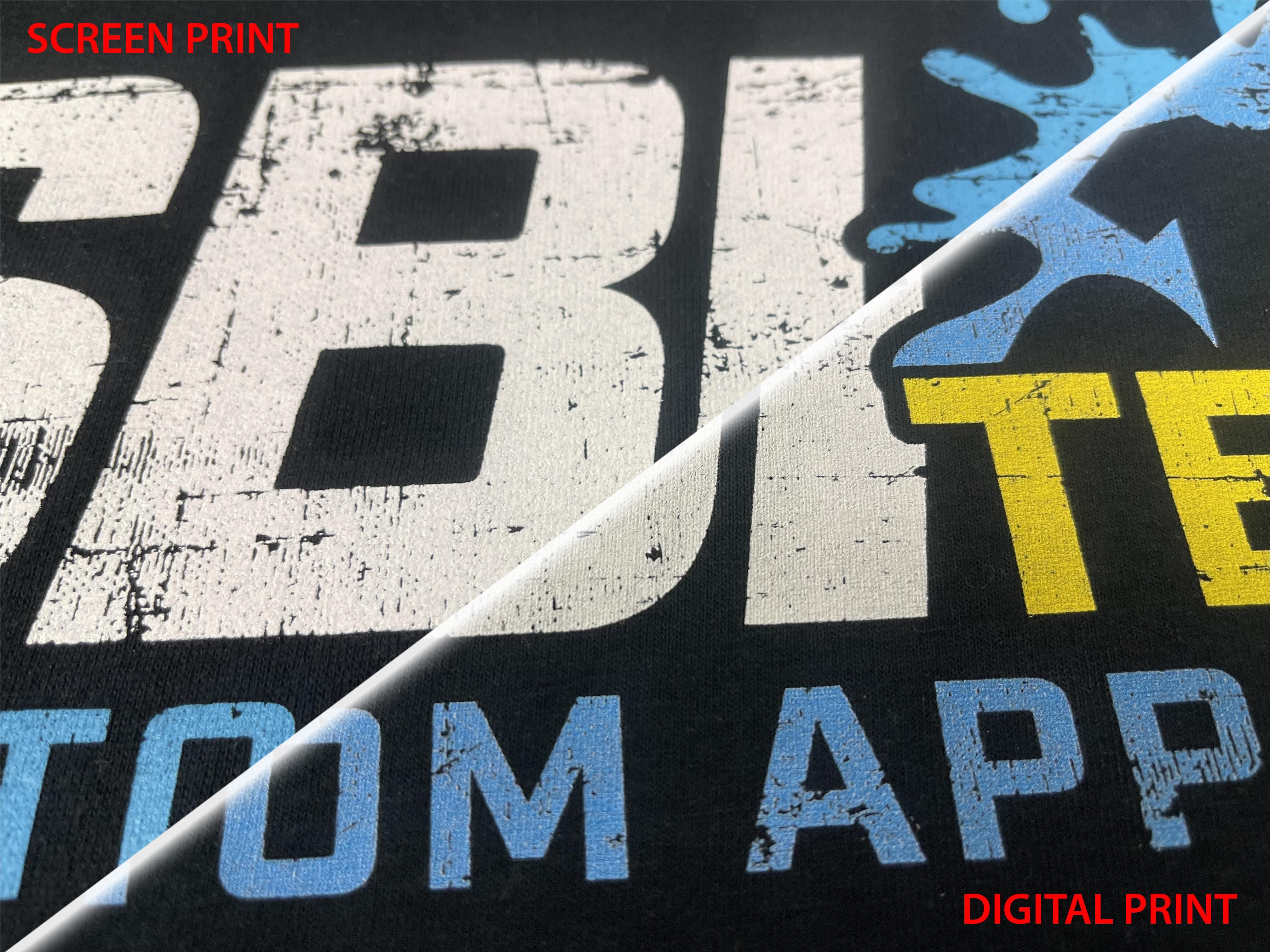
Particularly useful for detailed illustrations, photographic imagery and smooth color transitions. Print appearance is affected by fabric color, pretreatment, digital color management and ink coverage.
Screen Printing
Well suited to defined graphics and controlled spot colors. Detailed artwork can also be produced through halftones and separations, although screen preparation and registration become more demanding.
Color Accuracy and Consistency
DTG color reproduction depends on the artwork file, printer profile, ink system, fabric color and pretreatment. Screen printing introduces other variables, including ink formulation, mesh selection, screen exposure and registration.
When brand colors are critical, approving artwork on a computer screen is insufficient. The printed color should be evaluated on a physical sample made with the intended production fabric.
Does DTG Always Have a Softer Feel?
No. A lightly printed DTG graphic may feel relatively soft, but a large print on a dark garment with a substantial white underbase can feel more noticeable. Screen printing can also produce either soft or textured finishes depending on the ink and deposit thickness.
For clothing brands, print hand feel should be evaluated alongside opacity, flexibility, coverage and wash performance. These characteristics may be especially important for lightweight T-shirts, stretch garments and large chest or back prints.
DTG vs Screen Printing on Cotton, Polyester and Blends
Fabric compatibility is one of the most important factors in custom apparel printing. Fiber composition, fabric weight, surface texture, stretch and finishing treatments all affect how the print behaves.
| Fabric | DTG Considerations | Screen Printing Considerations |
|---|---|---|
| 100% Cotton Jersey | Common application; fabric surface and pretreatment affect results | Widely compatible with appropriate textile inks |
| Cotton-Polyester Blends | Fiber ratio and ink-system compatibility require testing | Ink and curing conditions must suit the blend |
| Polyester Activewear | Conventional cotton-focused systems may not be suitable | Compatible inks and dye-migration controls may be needed |
| Stretch Fabrics | Print flexibility and recovery require evaluation | Stretch-compatible ink systems may be necessary |
| Heavyweight Fleece | Surface texture and print coverage can affect appearance | Ink deposit and application settings must suit the surface |
For example, a smooth cotton jersey provides a different printing surface from brushed fleece. A polyester-rich performance fabric may also introduce dye-migration risks that are less relevant to some cotton garments.
The same design should therefore be tested on the intended production fabric rather than on a convenient substitute. This is especially important when a collection includes several fabric compositions or garment colors.
Fabric approval point: Confirm the fiber composition, GSM, surface finish, stretch characteristics and garment color before approving the printing method. These details can affect both the appearance and durability of the finished print.
DTG vs Screen Printing Cost: What Affects the Unit Price?
Printing cost depends on more than the number of garments. Artwork complexity, color count, print size, garment color, setup requirements and production efficiency can all influence the quotation.
DTG printing often avoids the need for separate physical screens, making it practical for smaller orders and frequent design changes. Screen printing involves more preparation, but its setup costs can be spread across a larger quantity of garments.
Understanding the Cost Drivers
| Cost Factor | DTG | Screen Printing | Buyer Consideration |
|---|---|---|---|
| Artwork Colors | Not usually priced by individual screen colors | More separations may require more screens and setup | Confirm the actual artwork and color requirements |
| Order Quantity | Per-garment machine time remains important | Setup cost per garment generally decreases as volume rises | Compare total quotations at planned quantities |
| Print Coverage | Large or dense graphics may increase ink use | Coverage affects ink consumption and process settings | Confirm artwork dimensions and placement |
| Garment Color | Dark garments may require additional preparation and white ink | Underbases or additional print passes may be required | Quote using the final garment color |
| Design Changes | Often easier to accommodate digitally | May require new screens or adjustments | Confirm whether artwork will remain unchanged |
Example: One Design, Three Order Quantities
Consider a clothing brand planning to print the same graphic on cotton T-shirts. The most economical method may change as the order develops.
| Order Scenario | What to Compare | Likely Consideration |
|---|---|---|
| 50 T-Shirts | DTG unit cost versus screen preparation and printing charges | DTG may avoid disproportionate screen setup costs |
| 500 T-Shirts | Artwork colors, setup allocation, print size and total production cost | Both methods may deserve quotation depending on the design |
| 2,000 T-Shirts | Production efficiency, repeat consistency, total cost and future reorders | Screen printing may offer an advantage for stable repeat artwork |
These quantities are illustrative scenarios, not fixed thresholds. A photographic full-color print and a simple one-color logo can produce very different quotations at the same order quantity.
A useful cost comparison should therefore include the total printing cost, setup charges, sample requirements, artwork specifications and any additional production steps. Comparing only a quoted unit price may overlook important differences.
DTG vs Screen Printing Durability and Wash Performance
Both DTG and screen printing can produce durable apparel graphics when the ink system, fabric and production conditions are properly matched. Neither method automatically guarantees better wash resistance.
The most important variables include:
- Ink compatibility: The selected ink must suit the garment fiber and finish.
- Pretreatment: DTG preparation must follow the requirements of the ink and equipment system.
- Curing: Incorrect time or temperature can affect wash durability.
- Stretch: Printed areas must tolerate the movement expected during wear.
- Laundering: Washing, drying, detergent and abrasion can influence the finished appearance.
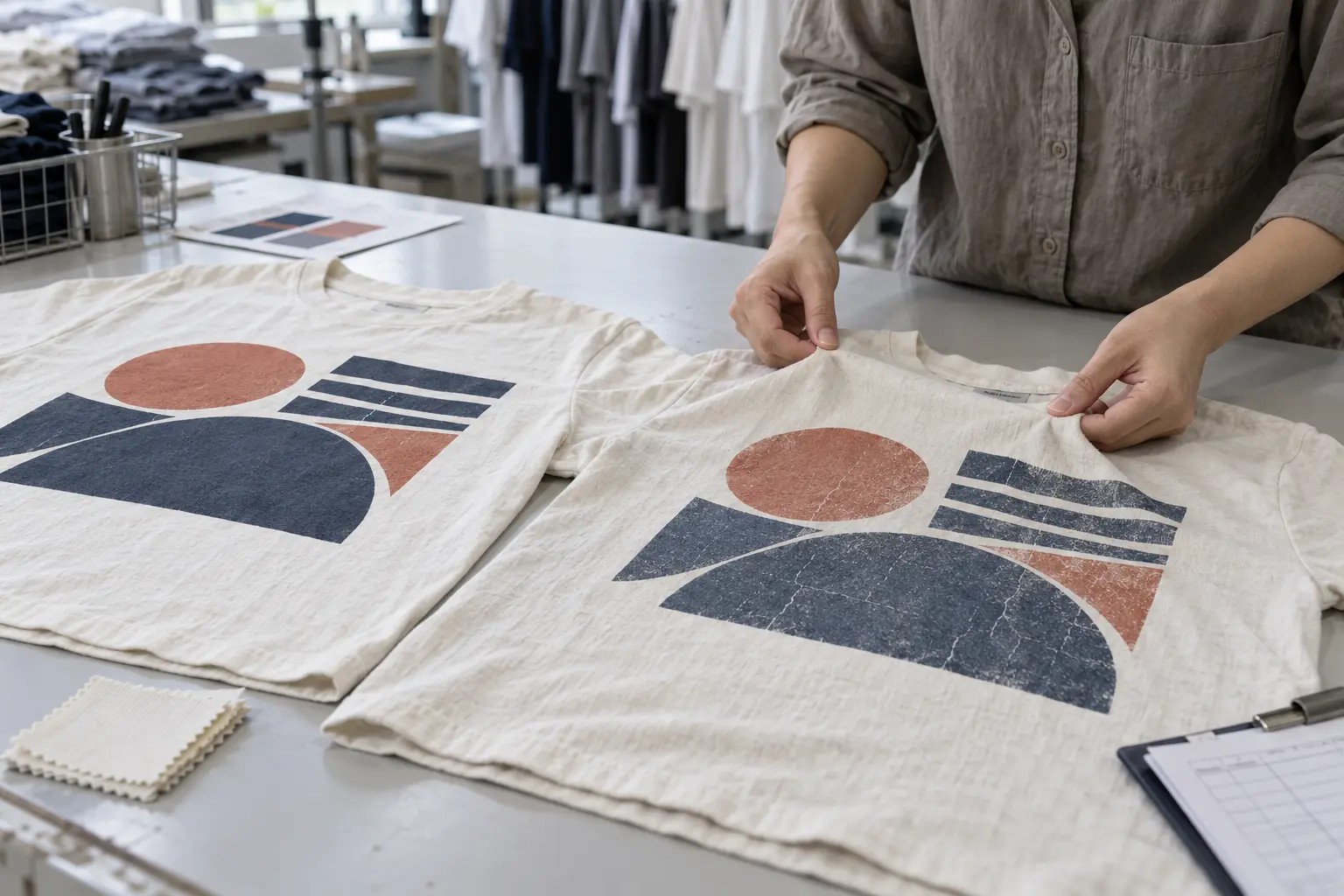
For bulk production, wash testing should be performed on a representative sample made with the intended fabric and printing process. Where relevant, brands should also evaluate rubbing resistance, stretch performance and the appearance of the print after repeated laundering.
Test methods and acceptance criteria should be agreed before production. A print that looks acceptable immediately after curing may behave differently after washing or extended wear.
Which Printing Method Should Your Clothing Brand Choose?
The most practical decision starts with the design, fabric and order plan. Instead of selecting a method based only on popularity, brands should evaluate the requirements of the finished garment.
Graphic T-Shirts with Multiple Designs
A brand launching several illustrated T-shirts in limited quantities may prefer DTG because artwork changes do not require separate physical screen sets. This can be useful during collection testing and early product development.
Branded Sweatshirts with a Repeating Logo
A stable two-color logo repeated across a substantial sweatshirt order may be better suited to screen printing. The setup process becomes more economical when the same approved design is produced repeatedly.
Polyester-Rich Activewear
For polyester performance garments, compatibility should be checked before comparing costs. An appropriate screen-printing system may be preferable to conventional DTG equipment designed for cotton-rich materials, but the final decision requires fabric-specific testing.
Heavyweight Hoodies with Large Back Prints
A heavyweight hoodie may support either method depending on the surface texture, artwork and desired hand feel. Large solid graphics, detailed illustrations and specialty effects can require different printing approaches even on the same garment.
Can DTG Samples Be Used for Screen-Printed Bulk Production?
Some clothing brands use DTG printing to evaluate artwork quickly during sampling, then consider screen printing when the design moves into larger-scale production.
This can be a practical development approach, but the DTG sample should not automatically be treated as the final approved reference for screen-printed bulk garments.
The two methods can produce different results in several areas:
DTG Development Sample
- Digital artwork reproduction
- Potentially smooth color gradients
- Ink coverage determined by the digital printing system
- Hand feel influenced by pretreatment and underbase
Screen-Printed Bulk Sample
- Artwork may require color separations and halftones
- Ink formulation may change color appearance
- Screen registration affects fine details
- Ink deposit can change print texture and feel
Before switching methods, the brand should approve a new physical sample made with the intended bulk printing process. Color, artwork detail, placement, hand feel and wash performance should be reviewed again.
This is especially important for brand-critical graphics, photographic artwork and prints that cover a large area of the garment.
Sampling principle: A digital sample may confirm design direction, but production approval should be based on a sample that represents the actual printing method, fabric and finishing conditions intended for bulk.
Common DTG and Screen Printing Problems in Bulk Production
Print quality can vary during bulk production if fabric characteristics, process settings or inspection standards are not properly controlled. Identifying these risks during development helps reduce rework and production delays.
| Potential Problem | Possible Cause | Production Check |
|---|---|---|
| Color Variation | Fabric shade, ink settings, pretreatment or ink mixing differences | Approved physical color standard and defined tolerances |
| Print Cracking | Unsuitable ink, excessive deposit, inadequate curing or fabric stretch | Wash and stretch evaluation on production fabric |
| Misaligned Artwork | Garment loading, registration or positioning variation | Placement measurements and first-piece approval |
| Uneven Coverage | Fabric texture, pretreatment variation or printing settings | Coverage reference and in-line checks |
| Dye Migration | Interaction between garment dyes and the printing system | Ink compatibility and curing tests |
| Different Print Feel | Changes in ink deposit, underbase or preparation | Approved hand-feel reference sample |
Quality control should not be limited to checking whether the graphic is visible and correctly positioned. The finished print also needs to meet the agreed requirements for color, opacity, flexibility and performance.
For repeat orders, maintaining a documented reference sample and approved process settings can help identify changes before they affect a large quantity of garments.
Apparel Printing Checklist Before Bulk Production
Before confirming a production order, brands should align the artwork, garment specifications and print standards with the manufacturer or printing partner.
- Artwork file: Confirm the final design, dimensions, resolution and required separations.
- Fabric specification: Approve fiber composition, GSM, surface finish, stretch and garment color.
- Print placement: Define measurements from garment reference points and acceptable tolerances.
- Color approval: Review a physical print using the intended production fabric.
- Hand feel: Confirm ink coverage, opacity, texture and flexibility.
- Process compatibility: Verify the relevant ink system, pretreatment and curing conditions.
- Wash performance: Review test results against agreed acceptance criteria.
- Bulk reference: Retain an approved sample for production comparison.
- Inspection plan: Establish first-piece, in-line and final quality checks.
These requirements are particularly important when printing is part of a wider garment development program involving fabric sourcing, fit approval, decoration and finishing.
A coordinated apparel development and production process can help align the approved sample with the requirements of repeatable bulk manufacturing.
Frequently Asked Questions About DTG vs Screen Printing
Is DTG printing better than screen printing?
Not in every situation. DTG is often practical for detailed artwork and smaller runs, while screen printing can be more efficient for stable graphics produced in larger quantities. The correct method depends on the garment, artwork and production plan.
Which printing method is cheaper for bulk orders?
Screen printing is frequently more economical for larger repeat orders because setup costs can be distributed across more units. However, color count, artwork complexity, print coverage and fabric requirements can change the result.
Can DTG printing be used on polyester?
Some specialized systems support polyester or blended fabrics, but conventional DTG equipment is commonly optimized for cotton-rich garments. Compatibility should be confirmed with the specific ink, printer and fabric.
Which method is better for photographic designs?
DTG is often convenient for photographic imagery and smooth gradients. Screen printing can also reproduce complex artwork using suitable halftones and color separations, but it generally requires more preparation.
Does screen printing last longer than DTG?
Neither method automatically lasts longer. Durability depends on ink compatibility, curing, fabric properties and laundering. Testing a representative printed sample is more reliable than assuming one technique is always superior.
Can a clothing brand switch from DTG to screen printing for bulk production?
Yes, but the switch requires new sample approval. Color reproduction, fine details, hand feel and wash performance may change when the printing method changes.
What should brands provide when requesting a printing quotation?
Brands should provide the artwork, print dimensions, placement, garment style, fabric composition, garment colors and estimated quantities. These details help determine the suitable process and the relevant cost factors.
Final Considerations for Clothing Production
The choice between DTG and screen printing should be based on the product rather than a fixed rule. DTG offers flexibility for detailed graphics and changing designs, while screen printing can offer efficiency when artwork is repeated across larger orders.
For clothing brands, the more important question is whether the selected method can deliver the required print appearance, fabric compatibility, cost structure and quality consistently.
Evaluating these factors during sampling helps prevent problems that become more expensive to correct once bulk production begins.
Developing a Custom Printed Apparel Collection?
When planning graphic T-shirts, sweatshirts or other printed garments, sharing the artwork, fabric specifications and estimated quantities early can make it easier to evaluate suitable production methods.