

How to Find a Reliable Clothing Manufacturer in China?
An actionable sourcing guide for startup clothing brands and growing fashion businesses.
Finding clothing manufacturers in China is relatively easy.
Finding one that understands your designs, can meet your quality expectations, and communicates clearly throughout production takes more work.
For a startup clothing brand, choosing the wrong supplier can mean more than a delayed order. It can lead to inconsistent sizing, unexpected costs, unsellable inventory, and a difficult first launch.
The solution is not to contact as many factories as possible.
It is to evaluate the right things, in the right order.
Article Overview
- Define Your Product Before Searching for a Factory
- Look for Relevant Manufacturing Experience
- Compare Quotations Beyond the Unit Price
- Understand the Real MOQ
- Use Sampling to Test the Working Relationship
- Verify Production and Quality Control
- Evaluate Communication Before You Commit
- Final Supplier Evaluation Checklist
- Final Thoughts
Step 1: Define Your Product Before Searching for a Factory
One of the most common sourcing mistakes happens before a brand contacts its first manufacturer.
The brand has a design idea but has not yet clarified the product requirements.
A supplier cannot provide a meaningful quotation based only on a reference photo and an estimated quantity.
Prepare a Basic Product Brief
- Product category: T-shirts, hoodies, dresses, activewear, or other garments.
- Fabric: Preferred composition, weight, texture, and performance.
- Design: Sketches, reference images, or a tech pack.
- Details: Printing, embroidery, trims, labels, and packaging.
- Quantity: Estimated units per style and color.
- Timeline: Target delivery date and key development milestones.
You do not need a perfect tech pack to begin a conversation.
But the more clearly you define your product, the easier it becomes to identify manufacturers with relevant capabilities.
Sourcing Workflow
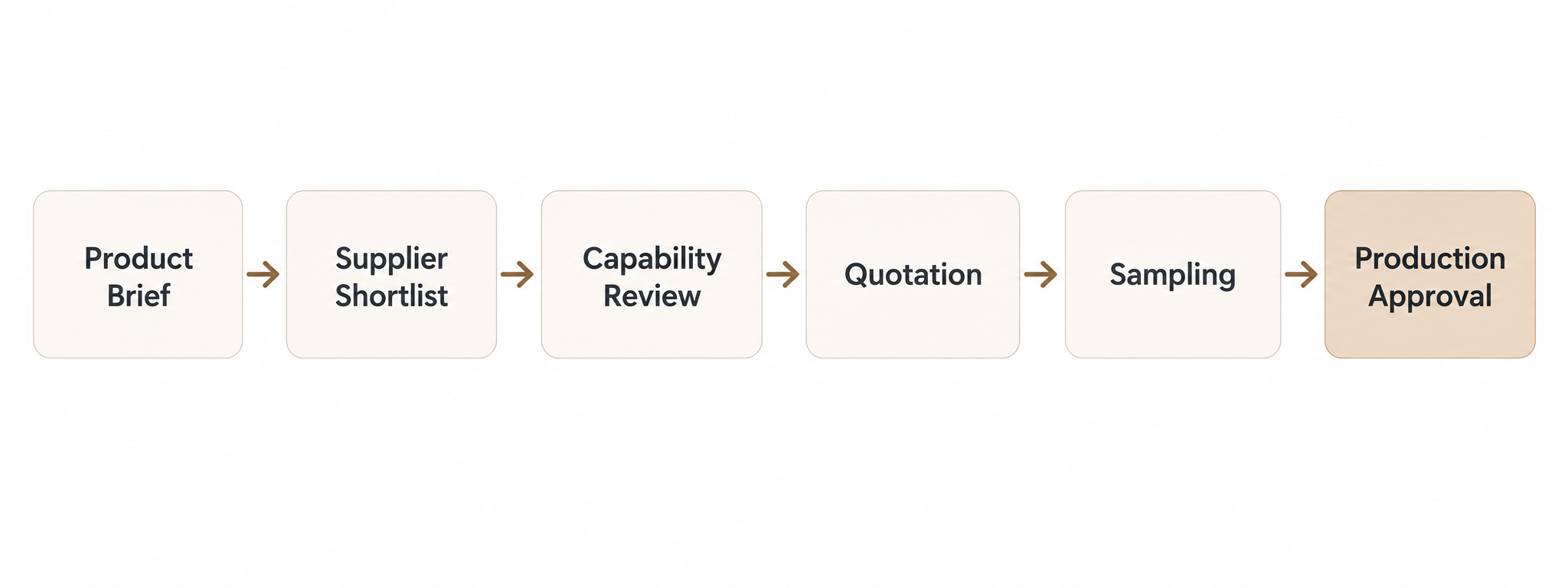
Each stage should answer a different question.
Do not move directly from receiving a quotation to placing a bulk order.
Step 2: Look for Relevant Manufacturing Experience
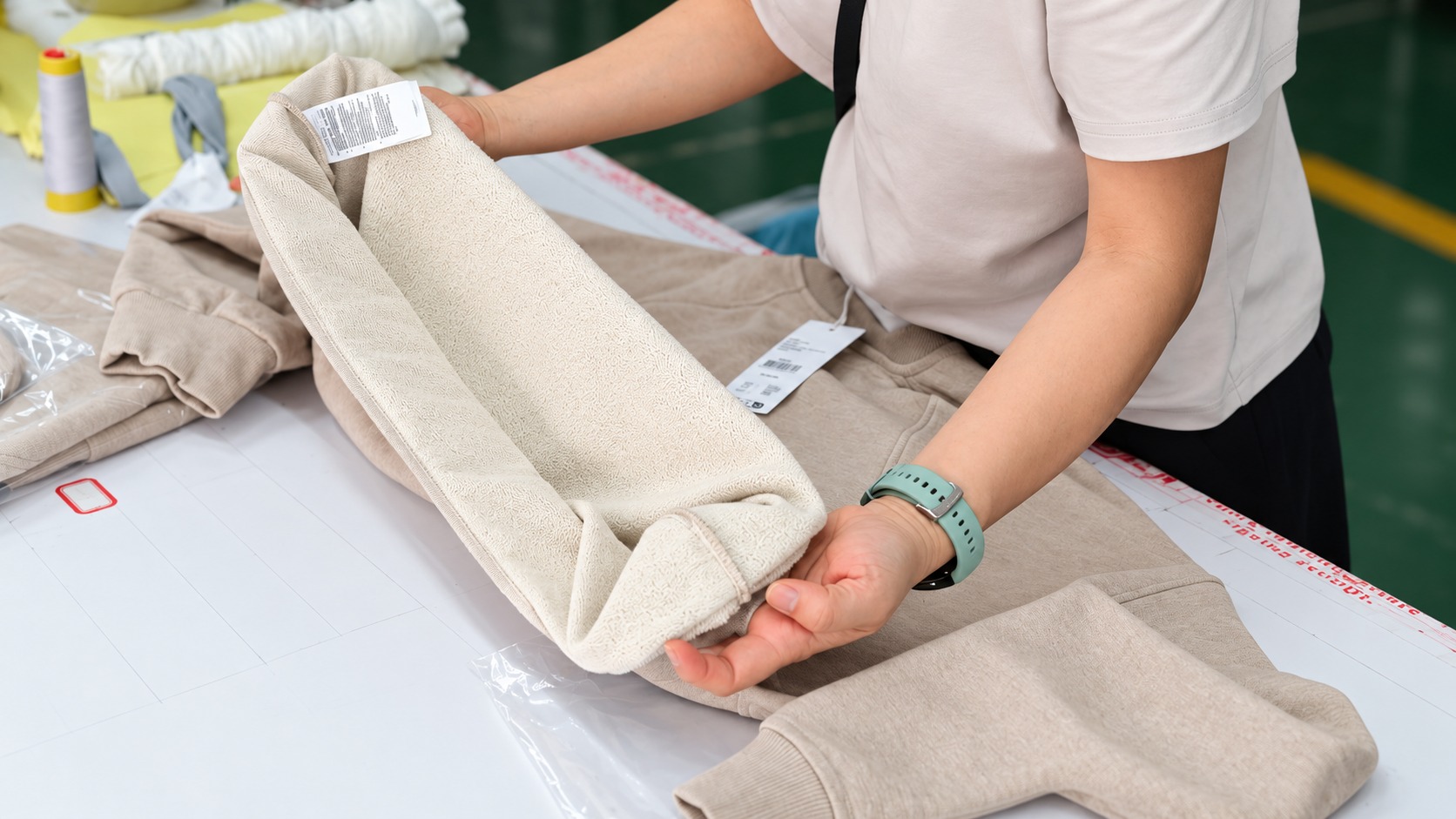
A factory that produces basic cotton T-shirts may not be experienced in garment-dyed sweatshirts, structured womenswear, or technical activewear.
These products involve different materials, equipment, construction methods, and quality risks.
For example, a heavyweight hoodie may require careful control of shrinkage, rib recovery, seam strength, and garment washing.
A lightweight blouse requires a different understanding of drape, seam finishing, fabric handling, and fit.
Questions to Ask Potential Suppliers
- Have you manufactured similar garments?
- Can you share relevant production samples?
- What technical challenges would you expect with this design?
- Which processes are handled in-house or by production partners?
A useful warning sign: The supplier immediately says, "Yes, we can make everything," without asking any questions about your specifications.
Experienced manufacturers should be able to explain both what is possible and what needs further testing.
Step 3: Compare Quotations Beyond the Unit Price
Imagine receiving two quotations for the same sweatshirt.
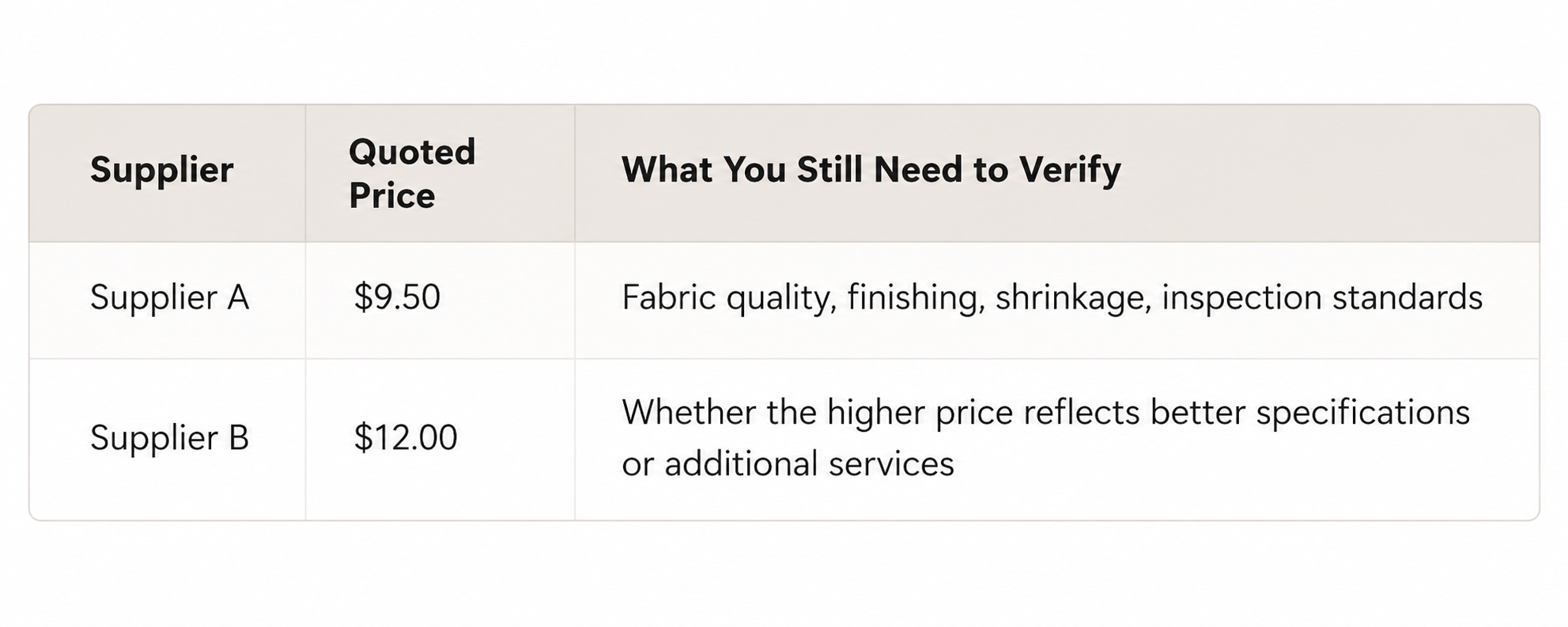
Prices are illustrative examples, not market quotations.
The cheaper option is not automatically worse. The more expensive option is not automatically better.
The important question is whether both suppliers are quoting the same product specification.
Compare fabric composition, GSM, construction, decoration, trims, packaging, and delivery terms.
A small difference in the original quotation can become significant if it results in rejected garments, rework, or missed launch dates.
Evaluate the total cost of getting an approved product delivered—not just the initial unit price.
Step 4: Understand the Real MOQ
Minimum order quantity (MOQ) is especially important for emerging clothing brands.
However, a factory's garment MOQ is not always the same as its fabric or color MOQ.
A manufacturer might accept a relatively small garment order, while the selected fabric requires a larger minimum purchase.
Custom dyeing, printing, specialty trims, and packaging can introduce additional minimums.
Before Committing, Clarify:
- Is the MOQ per style, per color, or per fabric?
- Can different sizes be combined?
- What happens if the requested quantity is below the fabric supplier's minimum?
- Are stock fabrics available as an alternative?
How MOQ Works
Garment MOQ
The minimum number of finished pieces a manufacturer can produce efficiently.
↓
Fabric MOQ
The minimum fabric quantity available from the textile supplier or mill.
↓
Color and Process MOQ
Additional requirements for custom colors, printing, dyeing, or trims.
↓
Final Feasible Order Quantity
The quantity that works across the complete production process.
A supplier who explains these limitations clearly is often more useful than one who promises a low MOQ without checking material availability.
Step 5: Use Sampling to Test the Working Relationship
A sample should reveal more than how the garment looks.
It should demonstrate how the manufacturer interprets your specifications, communicates technical issues, and responds to revisions.
What to Evaluate During Sampling
- Fabric: Does it match the agreed composition, weight, and hand feel?
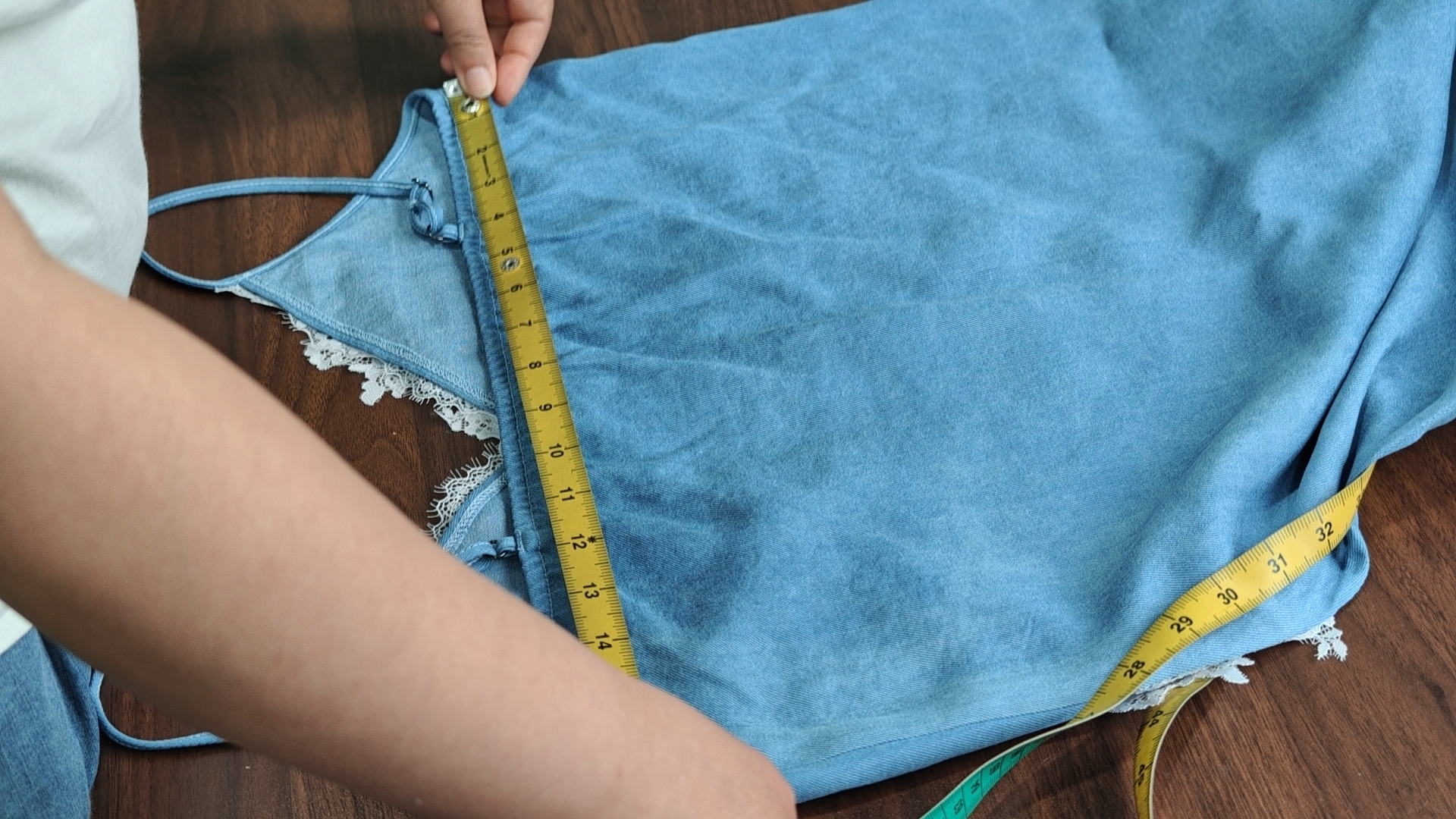
- Fit: Are measurements and proportions consistent with the specification?
- Construction: Are seams, stitching, and finishing appropriate?
- Decoration: Is the print or embroidery correctly positioned?
- Performance: Have relevant shrinkage, colorfastness, or wash requirements been considered?
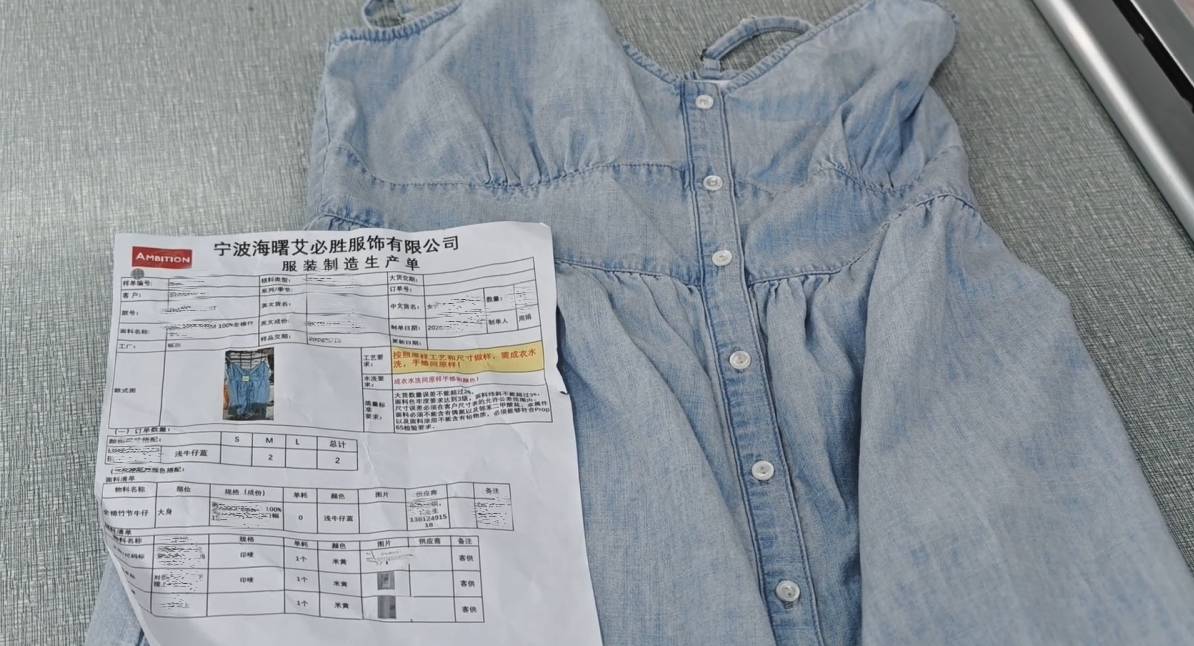
Pay attention to how revisions are handled.
If the first sample has an incorrect sleeve length, does the supplier confirm the measurement difference and document the correction?
Or do they simply promise that the next sample will be better?
The difference matters.
A reliable sampling process should turn feedback into clear, measurable production requirements.
Step 6: Verify Production and Quality Control
A professional website or attractive showroom can help you discover a manufacturer.
But it does not tell you how bulk production is controlled.
Before placing an order, ask about the actual production arrangement.
- Where will the garments be made?
- Who manages fabric sourcing, cutting, sewing, printing, finishing, and inspection?
- What happens if bulk fabric differs from the approved sample?
- How are defects identified before shipment?
A practical production-control sequence looks like this:
From Approved Sample to Bulk Production
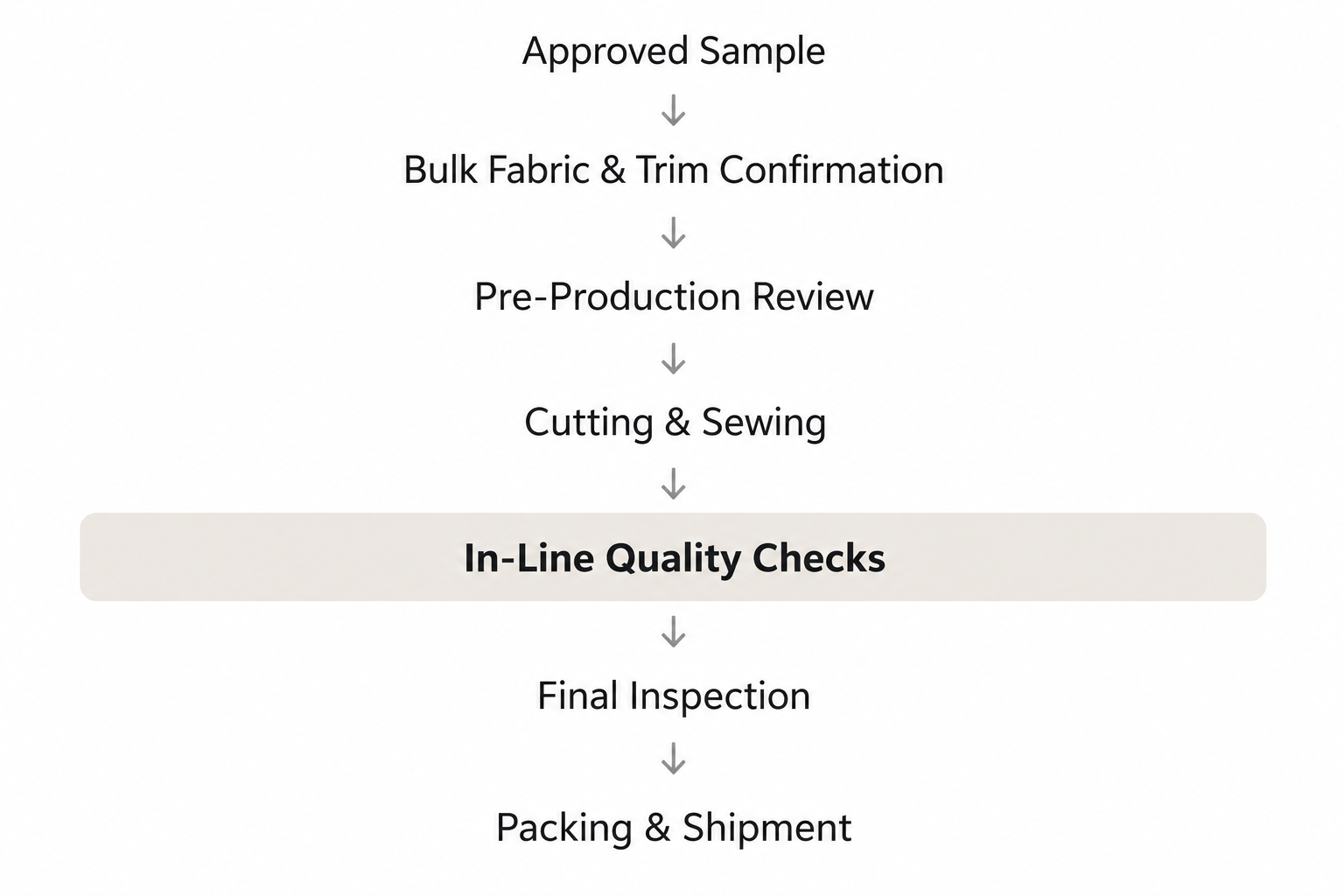
The exact workflow varies by product and factory, but the principle is consistent: quality should be checked throughout production, not only at the end.
For example, if a fabric lot has a different shrinkage rate from the approved sample, the problem should be identified before cutting.
Once hundreds of garments have been cut and sewn, correcting a material problem becomes much more difficult.
Step 7: Evaluate Communication Before You Commit
Communication problems often become production problems.
A supplier may have strong technical capabilities, but unclear specifications, delayed feedback, or undocumented changes can still lead to expensive mistakes.
Consider how the supplier responds when something is uncertain.
- Do they ask questions?
- Do they explain alternatives?
- Do they identify potential risks before production?
- Can they distinguish between a confirmed delivery date and an estimated timeline?
A reliable manufacturing partner does not need to agree with every request immediately.
Sometimes, the most valuable response is:
"This fabric may not achieve the hand feel you want at the requested weight. We should test an alternative before confirming bulk production."
That kind of communication helps brands make decisions while changes are still manageable.
Final Supplier Evaluation Checklist
Before choosing a clothing manufacturer in China, use this checklist to compare your shortlisted suppliers.
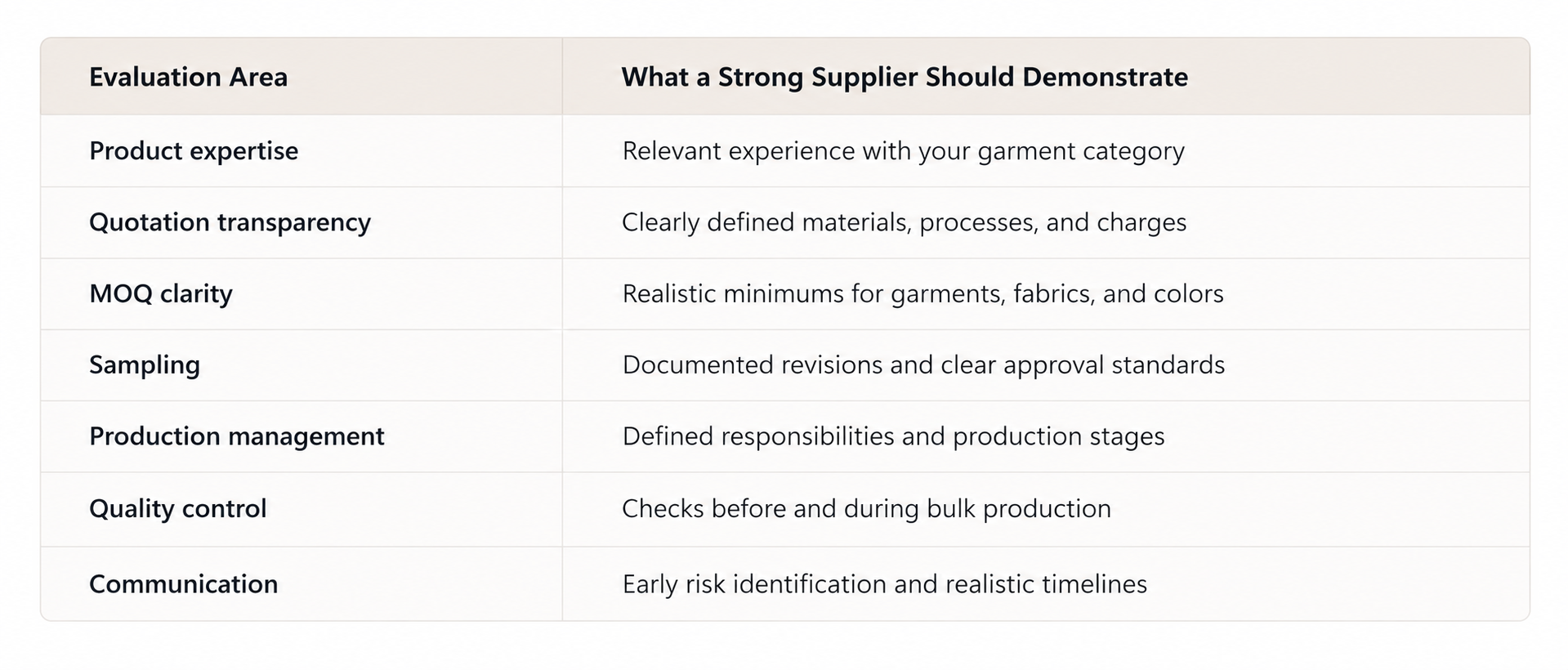
Do not judge a manufacturer on one attractive sample or one competitive quotation.
Look at how the different parts of the working relationship fit together.
Final Thoughts
Choosing a clothing manufacturer is not just a purchasing decision.
It influences your product quality, inventory risk, launch schedule, and ability to reorder consistently as your brand grows.
For startup clothing brands, the strongest sourcing strategy is not necessarily finding the lowest price or the largest factory.
It is finding a supplier whose product experience, production processes, and communication style match your requirements.
A reliable manufacturer should help you understand the risks before they become production problems.
That is what makes a sourcing relationship more valuable over time.