Why Apparel Supplier Quotes Vary for the Same Style?
In many cases, the quotes are based on different assumptions about fabric, fabric consumption, order quantity, construction, trims, finishing, testing, packing, production scope or commercial terms. If those assumptions are not aligned, comparing only the final unit price can be misleading.
This guide explains why apparel supplier quotes vary for the same style, what usually sits behind the difference, and what buyers should normalize before deciding which quotation is actually comparable.
Article Overview
- What an Apparel Quote Actually Represents
- 10 Reasons Supplier Quotes Can Differ
- Fabric Specification Is Different
- Fabric Consumption and Cutting Efficiency Differ
- MOQ and Order Structure Change the Cost
- Construction and Workmanship Are Quoted Differently
- Trims and Accessories Are Not Equivalent
- Printing, Embroidery and Washing Add Different Costs
- Quality Control and Testing Scope Varies
- Packing and Commercial Terms May Be Different
- Factory Capability and Production Model Affect Pricing
- Quote Timing and Validity Can Change the Number
- How Buyers Should Compare Apparel Quotes
- When a Supplier Quote Needs Clarification
- Questions to Ask Before Accepting a Quote
- Apparel Quotation FAQ
What an Apparel Quote Actually Represents
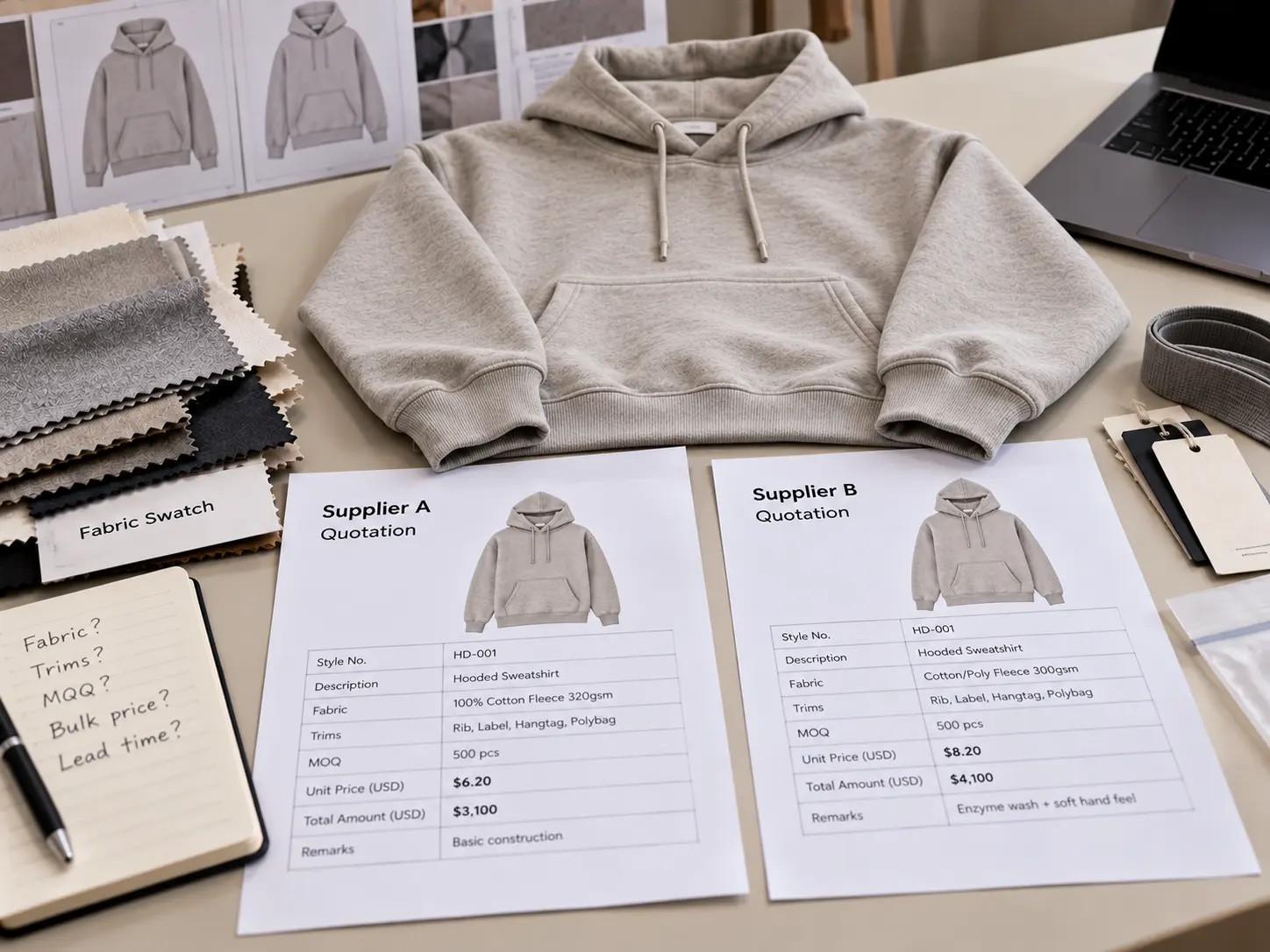
An apparel quotation is not simply a price attached to a sketch. It is the supplier's cost calculation based on a particular interpretation of the product and order conditions.
If the tech pack is incomplete, the supplier must fill in missing details with assumptions. One supplier may quote a 280 GSM fabric while another assumes 320 GSM. One may include custom zipper pulls and testing, while another may quote standard trims and exclude testing. Both quotes can appear to describe the same style while actually covering different products.
Key point: Before comparing prices, buyers need to make sure they are comparing the same product specification, quality standard and commercial scope.
A comparable quote should have a clear basis
- Style or tech pack version
- Fabric composition, GSM and finish
- Fabric width or consumption basis where relevant
- Order quantity and color breakdown
- Trim and branding requirements
- Printing, embroidery, washing or other special processes
- Packing requirement
- Incoterm, currency and payment basis
- Quotation validity period and stated exclusions
10 Reasons Supplier Quotes Can Differ
Composition, weight, yarn, finish and material source can all change fabric cost.
Usable width, marker efficiency, shrinkage and cutting allowance change cost per garment.
Order size and how quantity is divided by color, size and style affect efficiency.
Seams, stitching, reinforcement and workmanship standards change labor time.
Labels, zippers, elastics, buttons and packaging components may not be equivalent.
Printing, embroidery, washing, dyeing and finishing create additional cost layers.
Inspection scope, testing and tolerance requirements can be built into the quoted price.
Packaging, Incoterms, payment conditions and exclusions affect what the number covers.
Product specialization, setup requirements and outsourced processes affect costing.
Material prices, currency basis and quotation validity can change between costing dates.
1. Fabric Specification Is Different
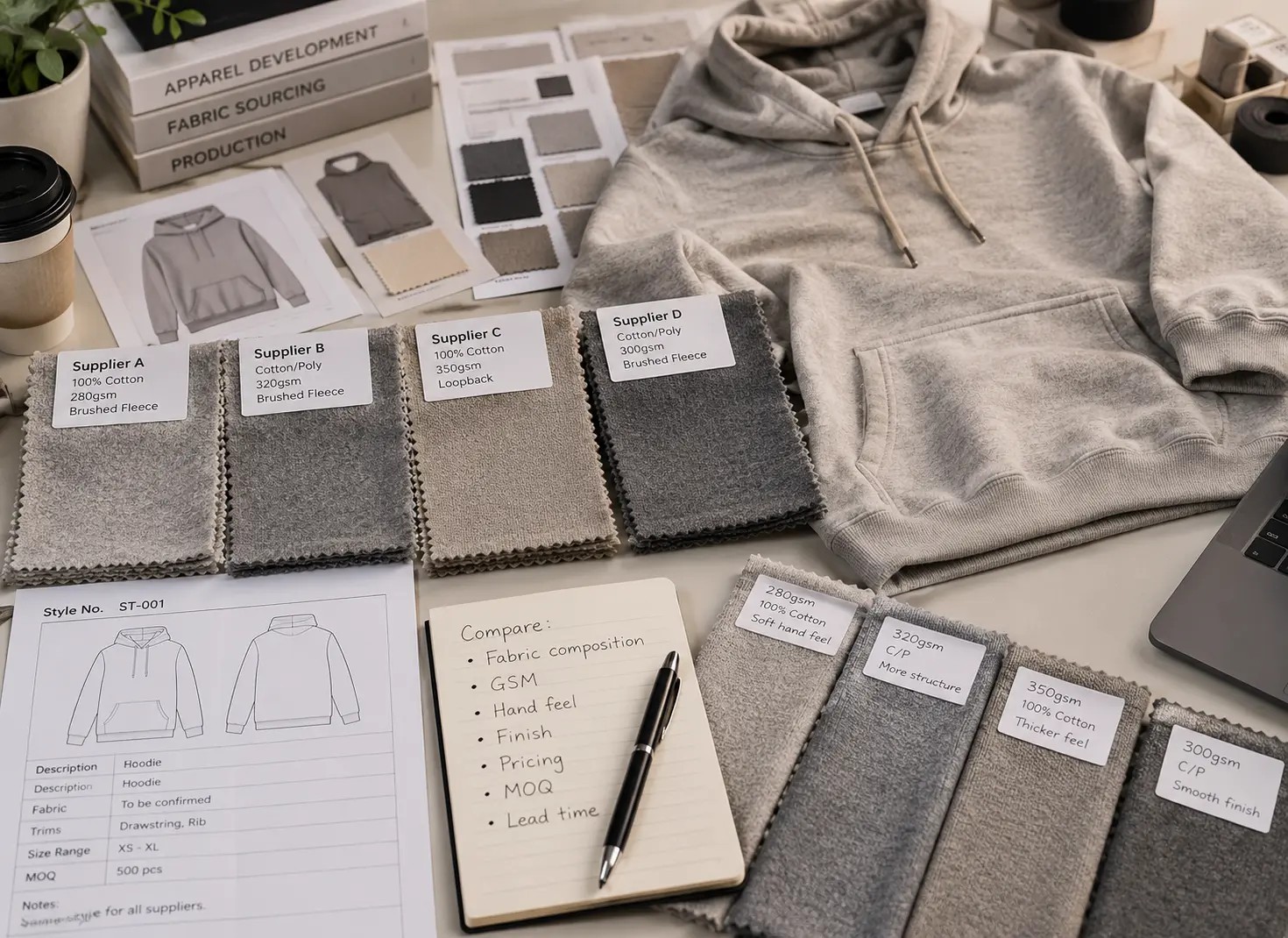
Fabric is often one of the largest cost components in a garment, so even a small difference in material specification can create a noticeable difference in unit price.
Two fabrics described as “cotton jersey” may differ in fiber grade, yarn count, GSM, knitting density, dyeing method, finishing, shrinkage performance and colorfastness. A brushed or peached finish, garment wash, enzyme treatment or special hand feel can add further cost.
What buyers should compare
- Fiber composition and exact blend ratio
- GSM or fabric weight
- Yarn count or fabric construction where relevant
- Dyeing and finishing requirements
- Shrinkage, colorfastness and performance requirements
- Whether the quote is based on stock fabric or custom development
A lower fabric cost can be completely valid if the material specification is different. The problem begins when that difference is not visible in the quotation.
apparel-quotation-fabric-cost-comparison
2. Fabric Consumption and Cutting Efficiency Differ
Even when two suppliers use the same fabric price, they may not calculate the same fabric cost per garment. The difference can come from fabric consumption.
Consumption depends on garment measurements, usable fabric width, marker efficiency, shrinkage allowance, cutting wastage and the size ratio in the order. Directional prints, nap, stripe matching or check matching can reduce marker efficiency further.
For example, if one supplier calculates 1.42 meters per piece and another calculates 1.52 meters for the same fabric, the garment cost will differ even before sewing begins.
What buyers should compare
- Usable fabric width
- Consumption per garment
- Marker or cutting efficiency where relevant
- Shrinkage allowance
- Cutting wastage allowance
- Whether stripes, checks, print direction or nap require matching
- Size ratio used for consumption calculation
Costing principle: Fabric cost is influenced by both the fabric price and the amount of fabric required to produce one garment.
3. MOQ and Order Structure Change the Cost
A quote for 300 pieces is not calculated the same way as a quote for 3,000 pieces. But total quantity alone is not enough. The way that quantity is divided can matter just as much.
For example, 1,200 pieces in one color are not costed the same way as 1,200 pieces split into six colors at 200 pieces each. More colors can mean additional dye lots, thread changes, cutting coordination, trim handling and production setup.
What buyers should compare
- Total order quantity
- Quantity per color
- Number of sizes and SKUs
- Fabric, dye-lot and trim minimums
- Whether small-lot surcharges are included
This is why MOQ should be evaluated together with the product specification. A supplier may accept a smaller garment quantity but still need to purchase a full fabric or trim minimum.
4. Construction and Workmanship Are Quoted Differently
Two suppliers can look at the same reference image and interpret the construction differently unless the tech pack clearly defines it.
A basic seam and a reinforced seam do not require the same labor. Binding, coverstitching, double-needle stitching, lining, pocket construction, matching stripes, complex collars or detailed topstitching can all increase sewing time.
The difference may be especially visible when one supplier prices from an approved sample while another prices only from a front-and-back sketch.
What buyers should compare
- Seam and stitch construction
- SPI or stitch-density requirements where relevant
- Reinforcement and bartack requirements
- Pocket, collar, waistband and lining construction
- Measurement tolerance and workmanship standard
When the style is still being defined, a clear clothing design and development process can reduce quotation gaps by giving suppliers a more complete construction reference.
5. Trims and Accessories Are Not Equivalent
Zippers, buttons, elastic, drawcords, labels, snaps, hangtags and packaging materials can create a larger cost difference than buyers expect.
One supplier may quote a standard zipper while another uses a specified branded zipper. One may include custom woven labels and printed care labels, while another treats those items as additional charges after order confirmation.
What buyers should compare
- Trim supplier or brand where specified
- Custom versus stock components
- Label quantity and construction
- Hardware finish and plating
- Packaging components included in the unit price
6. Printing, Embroidery and Washing Add Different Costs
Special techniques can change both material and labor cost. A small flat embroidery and a large 3D foam embroidery are not priced the same. A one-color screen print is different from a multi-color print, and a basic garment wash is different from an acid wash or more complex vintage finish.
Cost can also change with artwork size, placement, number of colors, stitch count, print coverage, process minimums and whether repeated sampling is required.
What buyers should compare
- Technique type
- Artwork size and placement
- Number of colors
- Embroidery stitch count or print coverage where relevant
- Wash or finishing standard
- Sampling and setup charges
For graphics-heavy products, confirming the intended technique through a custom printing development process helps make the quotation more comparable before bulk production.
7. Quality Control and Testing Scope Varies
Quality cost is not always shown as a separate line item. It can be built into the unit price through inspection labor, measurement control, testing, process monitoring and other quality-management requirements.
For example, one quote may assume routine factory QC, while another includes stricter inline inspection, third-party testing requirements or additional checks for colorfastness, shrinkage and performance.
What buyers should compare
- Inspection standard and frequency
- Testing requirements
- Measurement tolerance
- Third-party inspection or laboratory charges
- Whether reinspection requirements are included or quoted separately
Buyer takeaway: A higher quote may include quality-control steps that are absent from a lower quote. That does not automatically make the higher quote better, but the scope should be visible before the prices are compared.
8. Packing and Commercial Terms May Be Different
Two quotations can show similar garment costs but different commercial conditions. Polybags, tissue paper, hangtags, size stickers, cartons, inserts and custom retail packaging all affect the final cost.
Incoterms matter because they define different scopes of responsibility. An EXW price generally ends the supplier's responsibility earlier, while FOB pricing may include export documentation, local handling and delivery to the agreed port. The two prices should not be compared as though they cover the same services.
Payment terms do not always change the unit price, but longer credit periods or different financial arrangements can affect the supplier's commercial calculation.
What buyers should compare
- Individual packing method
- Carton specification
- Hangtags, barcode labels and stickers
- Incoterm used in the quotation
- Payment terms
- Whether local handling, testing, inspection or freight-related costs are excluded
9. Factory Capability and Production Model Affect Pricing
Suppliers do not all operate with the same production structure. Some manage fabric development, sampling, cutting, sewing and finishing through an integrated production network. Others outsource more stages or specialize in a narrower product range.
Neither model is automatically better or cheaper. But it affects overhead, minimums, lead time, process control and the amount of coordination included in the quotation.
A supplier experienced in the product category may achieve better sewing efficiency, fabric utilization and process coordination even if its nominal labor rate is not the lowest. A factory unfamiliar with the construction may need more setup time, specialist operators or external processing.
What buyers should compare
- Whether the supplier regularly produces the product category
- Which processes are handled directly and which are outsourced
- Sampling and development scope
- Production capacity for the required delivery window
- Whether coordination and setup requirements are already built into the price
10. Quote Timing and Validity Can Change the Number
The same supplier may not quote the same price indefinitely. Fabric, yarn, trims, exchange-rate assumptions and applicable local commercial costs can change between one costing date and another.
That is why quotation validity matters. If a price was calculated several weeks or months earlier, the supplier may need to reconfirm material prices or commercial assumptions before the order is placed.
What buyers should compare
- Quotation date
- Validity period
- Currency used
- Whether material prices are fixed or subject to reconfirmation
- Whether the quoted quantity and delivery window are still unchanged
How Buyers Should Compare Apparel Quotes
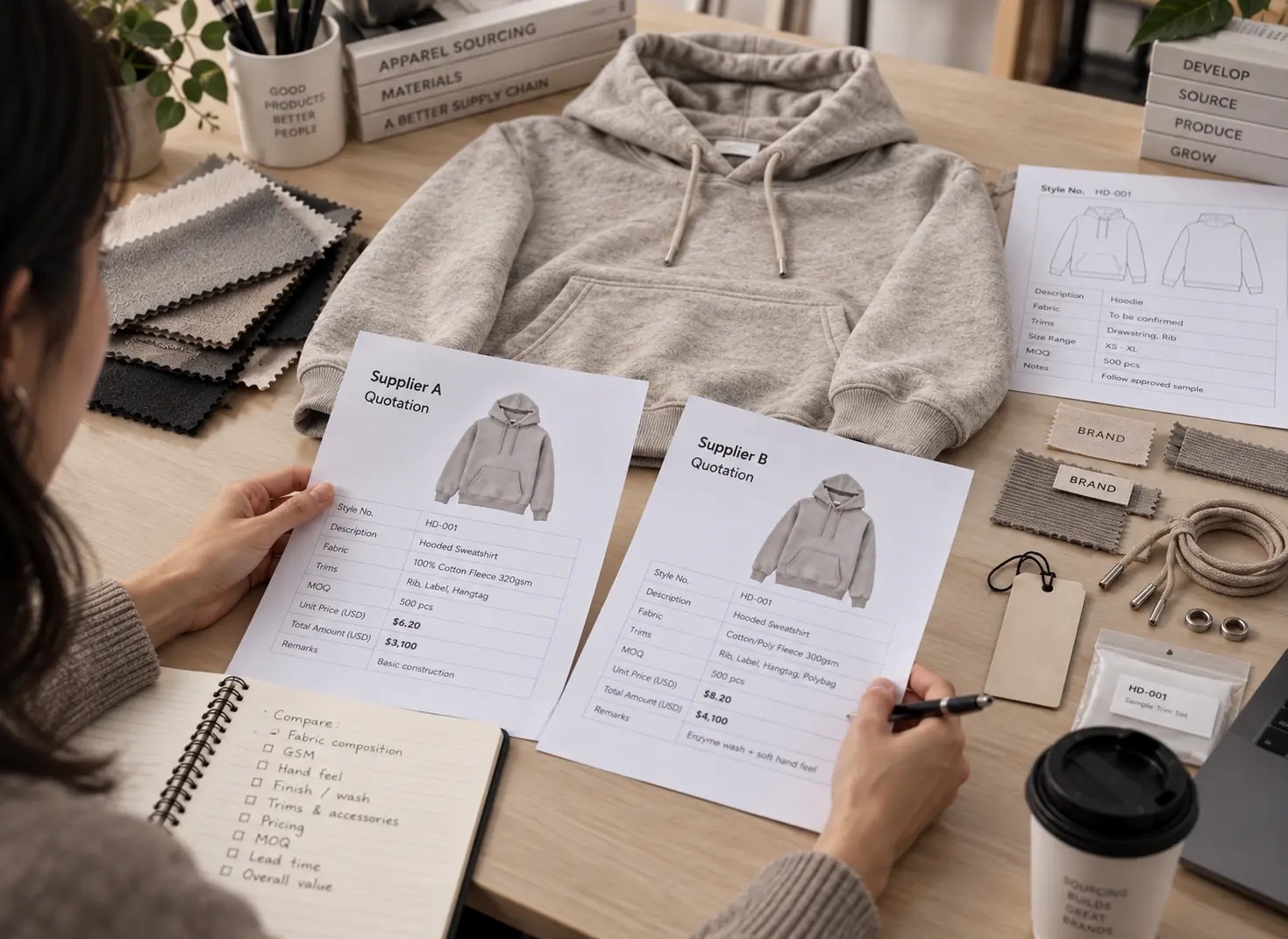
The most useful comparison is not “Supplier A is $0.80 cheaper.” It is whether Supplier A and Supplier B are pricing the same specification and taking responsibility for the same scope.
| Quotation Item | What to Confirm | Why It Changes Price |
|---|---|---|
| Fabric | Composition, GSM, finish, color and supplier basis | Material specification can significantly change unit cost |
| Consumption | Usable width, consumption, shrinkage and cutting allowance | Different fabric usage changes cost per garment |
| Order Structure | Total quantity, colors, sizes and SKU split | Smaller runs create more setup and handling |
| Construction | Seams, stitching, reinforcement and workmanship | More operations increase labor time |
| Trims | Brand, material, finish and customization | Custom or branded components carry different minimums and costs |
| Decoration | Print, embroidery, wash, placement and coverage | Each process adds setup, labor and material cost |
| Quality & Testing | Inspection, tolerance and laboratory requirements | Additional control and testing add time and cost |
| Packing | Polybags, labels, cartons and retail packaging | Packaging scope may be included or excluded |
| Commercial Terms | EXW/FOB basis, payment terms and exclusions | Different responsibilities make headline prices incomparable |
| Quote Basis | Currency, validity period and costing date | Input costs may change between quotation dates |
A useful approach is to normalize the quotes first. Put the same specification, quantity, packing requirement and commercial terms into one comparison sheet. Differences that remain after that are much more meaningful.
Quotation Comparison Checklist
- Same fabric composition, GSM and finish
- Same fabric width or consumption basis where relevant
- Same color and size breakdown
- Same construction and workmanship standard
- Same trims and branding components
- Same printing, embroidery or wash specification
- Same QC and testing requirements
- Same packaging scope
- Same Incoterm and currency
- Same quotation validity or costing period
- Sampling, setup or tooling charges identified
- Exclusions clearly listed
When a Supplier Quote Needs Clarification
A short quote is not necessarily a weak quote, but certain missing details make price comparison difficult. Clarification is useful when the number cannot be tied back to a clear product and commercial basis.
- The fabric is described only as “cotton,” “polyester” or another broad term with no weight or finish.
- The unit price is shown without the quantity or color split it is based on.
- The fabric consumption basis is unclear for a fabric-heavy or size-sensitive style.
- Special processes are marked “TBC” but the final unit price appears fixed.
- Testing, inspection, labels or packaging are not listed as included or excluded.
- The Incoterm is missing.
- The quote has no validity period.
- The price changes after sampling but the reason for the revision is not explained.
The purpose of asking for clarification is not to make every quotation longer. It is to identify the few assumptions that could materially change the final order cost.
Questions to Ask Before Accepting a Quote
A quotation becomes more useful when buyers understand what is behind the number. Before accepting a price, clarify the assumptions that could change after sampling or order confirmation.
- What exact fabric specification is this price based on?
- What fabric width or consumption basis is being used?
- What quantity and color split does the price assume?
- Are all trims, labels and packaging included?
- Which decoration or finishing processes are included?
- Are testing and inspection charges included or separate?
- Is the price EXW, FOB or based on another Incoterm?
- What could cause the quoted price to change after sampling?
- How long is the quotation valid?
The objective is not to force every supplier to arrive at the same number. It is to understand why the numbers are different and whether each quote reflects the product you actually intend to manufacture.
Apparel Quotation FAQ
Why can two apparel suppliers quote very different prices for the same design?
They may be using different assumptions for fabric specification, fabric consumption, construction, trims, quantity, finishing, quality control, packing or commercial terms. The reference image may be the same, but the quoted product and scope may not be.
Does the lowest apparel quote always mean lower quality?
No. A supplier may have more efficient production, stronger material purchasing conditions, better fabric utilization or more experience with the product category. The important step is to confirm whether the lower quote covers the same specification and scope.
Why does the price change after sampling?
Sampling can reveal details that were unclear at quotation stage, such as higher fabric consumption, additional sewing operations, special trims, revised measurements or more complex finishing. A complete tech pack and clear sample comments help reduce those changes.
Should buyers compare only unit price?
No. Unit price should be reviewed together with MOQ, fabric specification, consumption basis, quality standard, lead time, testing, packing, payment terms and the responsibilities included in the quotation.
What information helps suppliers quote more accurately?
A detailed tech pack, fabric specification, quantity breakdown, colorways, size range, trim requirements, artwork, packaging instructions, quality expectations and target Incoterm give suppliers a clearer basis for costing.
Need a quotation for a new apparel style?
Share your tech pack, reference sample, quantity breakdown and material requirements so the costing basis can be reviewed before pricing.